
 Available in GB
Content
- The Gambling Act 2005 and Offshore Operators
- UKGC Enforcement Against Unlicensed Sites in 2025-2026
- Is the Player Breaking the Law?
- GamStop Bypass: Why Non-GamStop Casinos Are a Safeguarding Gap
- New UK Rules: Stake Limits, Affordability Checks, and Levy
- The Protection Gap: What You Lose at an Offshore Casino
- Frequently Asked Questions
- Related guides in this section

A few months ago, a UK player contacted me through a forum after Rouge Casino froze his account and refused to release a withdrawal of just over two thousand pounds. He wanted to know his options. I asked which regulator he planned to complain to. There was a long pause. He had not considered the question, because he had not considered that Rouge Casino operates outside UK jurisdiction entirely. That realisation — the moment a player understands that the legal framework they assumed was protecting them does not apply — is something I encounter regularly. It is the central issue with offshore gambling for UK residents, and it is what this article addresses.
The UK has one of the most comprehensive gambling regulatory systems in the world. The Gambling Act 2005, the UK Gambling Commission, the GamStop self-exclusion scheme, the new stake limits and affordability checks introduced in 2025 — these are not abstractions. They are specific mechanisms that protect players at licensed operators every day. Between the start of 2025 and the end of 2026 the Commission completed 741 cease-and-desist actions and referred close to 398,000 illegal gambling URLs to search engines for delisting. That enforcement activity reflects how seriously the regulator treats unlicensed operators targeting UK players.
Rouge Casino holds a Curaçao licence. It does not hold a UKGC licence. That single fact determines everything that follows: which laws apply, what protections exist, what recourse is available, and what risks the player accepts. The legal position is not ambiguous, but it is widely misunderstood. Many players assume that if they can access a casino from a UK IP address, it must be legal and regulated in the UK. That assumption is wrong, and the consequences of acting on it can be significant.
The full assessment is in our Rouge Casino review.
The Gambling Act 2005 and Offshore Operators
I have read the Gambling Act 2005 more times than I care to admit, and I can tell you that the legislation is clearer on this point than most people realise. Section 33 makes it a criminal offence to provide facilities for gambling unless you hold a licence issued by the Gambling Commission. The Act does not distinguish between domestic and foreign operators in this regard — if you offer gambling services to people in Great Britain, you need a UKGC licence. Full stop.
The Act was designed for a pre-internet gambling landscape but was updated through the Gambling (Licensing and Advertising) Act 2014 to address exactly the situation that offshore operators now exploit. Before 2014, operators based overseas could legally serve UK customers without a UKGC licence, provided they held a licence from an approved jurisdiction. The 2014 amendment changed the licensing model from a “point of supply” basis to a “point of consumption” basis. Any operator serving UK customers now requires a UKGC licence, regardless of where the operator is based or which other jurisdiction has licensed it.
This is where Rouge Casino’s position becomes legally straightforward. The operator holds a Curaçao licence. Curaçao is not on the UKGC’s list of approved jurisdictions, and even if it were, the point-of-consumption model means the operator would still need a separate UKGC licence to legally serve UK players. As of March 2025, approximately 2,200 gambling operators held UKGC licences (UKGC annual report 2024/25), down year-on-year as the regulator tightens compliance standards. Rouge Casino is not among them.
The practical implication is that Rouge Casino, by accepting UK players without a UKGC licence, is operating in contravention of UK gambling law. The operator may argue that it is licensed in Curaçao and therefore legitimate. That argument holds no weight under UK law. A Curaçao licence authorises the operator to provide gambling services in jurisdictions that recognise that licence. The UK does not.
There is a common misconception that the Gambling Act only applies to operators physically located in Britain. It does not. The Act’s reach extends to any operator who provides or purports to provide gambling facilities to persons in Great Britain, regardless of where the operator’s servers, offices, or corporate registration are located. The internet does not create a jurisdictional loophole — it is precisely the scenario the 2014 amendment was designed to address. When I explain this to players who have been using offshore sites, the response is almost always the same: they had no idea the operator was breaking UK law by accepting their custom.

The Act’s three licensing objectives — and what they mean in 2026
The Gambling Act 2005 frames every UKGC licence around three statutory objectives: preventing gambling from being a source of crime or disorder; ensuring gambling is conducted in a fair and open way; and protecting children and other vulnerable persons from being harmed or exploited by gambling. Every UKGC licence condition under the LCCP traces back to one of those three objectives — affordability checks under the protection objective, transaction monitoring under the crime objective, RNG certification and bonus-term disclosure under the fairness objective.
Material offences under the Act include providing facilities for gambling without a licence (Section 33 — the offence that catches offshore operators when their activities can be sited within the UK), inviting children to gamble (Section 46), and using cheating systems (Section 42). The Act is enforced in the UK against operators with sufficient UK nexus; for purely offshore operators serving UK players via a Curaçao-licensed website, enforcement runs through the UKGC’s URL-block referrals, advertising restrictions under the Advertising Standards Authority, and payment-processor pressure rather than direct prosecution.
The 2023 White Paper and the path to current law
The April 2023 White Paper “High stakes: gambling reform for the digital age” set the policy direction for the legislative and regulatory reforms now landing in 2025–2026: the £5 and £2 online-slot stake limits, the £150 affordability threshold, the statutory levy, and the Remote Gaming Duty rise from 21% to 40%. The White Paper was the product of a Gambling Act 2005 review launched in 2020 that concluded the 2005 Act needed modernisation for online-first gambling rather than wholesale replacement. The current reforms therefore amend the LCCP and the Act’s operational regulations rather than introducing a new principal Act.
One consequence is that the legal framework UK players encounter in 2026 is not a single new law but the cumulative effect of LCCP amendments layered onto the 2005 Act. This is why the offshore-vs-UKGC contrast keeps growing wider: the UKGC framework keeps adding protections; the Curaçao framework does not match those additions in lockstep, and the protection gap that opens with each reform persists at offshore operators by default.
UKGC Enforcement Against Unlicensed Sites in 2025-2026
Every quarter, I review the UKGC’s enforcement reports, and the trajectory over the past two years is unmistakable: the Commission is investing more resources in targeting unlicensed operators than at any point since its inception.
The numbers tell the story. Between 2025 and 2026, the UKGC issued 741 cease-and-desist notices to unlicensed operators and reported nearly 398,000 URLs associated with illegal gambling sites to search engines for delisting. Those are not warning letters filed in a drawer. Cease-and-desist notices carry legal weight and can be escalated to criminal prosecution if the operator continues to target UK consumers. The URL reporting programme works with Google, Bing, and other search providers to remove illegal gambling sites from search results, reducing the visibility that offshore operators depend on to attract UK players.
UKGC senior officials have been unambiguous in their public communications throughout 2025: compliance is not optional. That phrasing — repeated across speeches, press releases, and regulatory guidance — signals a shift from the Commission’s historically reactive posture to a proactive enforcement strategy. The Commission is not waiting for complaints. It is actively scanning the market for unlicensed operators serving UK players and taking enforcement action before harm occurs.
The enforcement toolkit has expanded beyond cease-and-desist notices. The UKGC works with payment processors to block transactions between UK players and unlicensed operators. It collaborates with international regulators — including, increasingly, the Curaçao Gaming Authority — to share intelligence on operators who hold offshore licences while illegally targeting regulated markets. And it has increased its use of Section 336 powers under the Gambling Act, which allow the Commission to pursue criminal prosecution of individuals behind unlicensed operations.
For Rouge Casino specifically, the enforcement picture is this: the site operates without a UKGC licence while accepting UK players. Whether the UKGC has already issued enforcement action against this specific operator is not always publicly disclosed — the Commission does not publish a comprehensive list of every cease-and-desist notice. But the regulatory position is clear. Any operator serving UK players without a licence is a target for enforcement, and the scale of enforcement activity in 2025-2026 demonstrates that the UKGC has the capacity and the will to act. The question is not whether unlicensed operators face consequences, but when those consequences arrive for any given operator.

Is the Player Breaking the Law?
This is the question I get asked more than any other, and the answer surprises most people: no, the player is not breaking the law by gambling at an offshore casino.
The Gambling Act 2005 criminalises the provision of unlicensed gambling facilities. It does not criminalise the act of gambling at an unlicensed site. The legal liability sits entirely with the operator. A UK player who places a bet at Rouge Casino is not committing a criminal offence. The operator, by accepting that bet without a UKGC licence, is.
This distinction is important, but it creates a false sense of security. The fact that you are not committing a crime does not mean you are protected. It means, quite precisely, that the law will not punish you for gambling offshore. It does not mean the law will help you if something goes wrong. The UKGC’s jurisdiction extends to licensed operators. If Rouge Casino refuses a withdrawal, manipulates game outcomes, or closes your account without returning your balance, the UKGC cannot intervene because it has no regulatory authority over an unlicensed operator. You cannot file a complaint with the Commission, you cannot escalate to an approved Alternative Dispute Resolution provider, and you cannot invoke the consumer protections that apply to licensed gambling services.
I explain it to players this way: imagine buying a product from a shop on the high street versus buying the same product from someone operating out of a van in a car park. In both cases, you are legally buying a product. But if the product is faulty, the high-street shop is subject to consumer protection law, trading standards, and a physical address where you can pursue a claim. The van might be gone tomorrow. You have not broken any law by buying from the van, but you have voluntarily stepped outside the system that would protect you if something went wrong.
The legal nuance extends to financial transactions. UK banks and payment processors are not prohibited from processing deposits to offshore casinos, but some have voluntarily implemented blocks on transactions to known unlicensed gambling sites. If your bank blocks a deposit to Rouge Casino, that is a policy decision by your bank, not a legal prohibition on you. Conversely, if you deposit successfully, the lack of a block does not mean the site is licensed or legitimate — it means your bank has not flagged it.

The licence behind the operator: Curaçao vs UKGC.
GamStop Bypass: Why Non-GamStop Casinos Are a Safeguarding Gap
I spent a week last year interviewing players who had self-excluded through GamStop and then found their way to offshore casinos. Every single one of them described the same experience: GamStop worked exactly as intended at every UKGC-licensed site, and it was completely invisible at every offshore site. That gap is not a bug in the system. It is the system working as designed — and its limitations being exploited by operators who are not required to participate.
GamStop — the UK’s national online self-exclusion scheme — allows players to exclude themselves from all UKGC-licensed online gambling operators for a minimum of six months. All UKGC licence holders are required to participate. When a player registers with GamStop, every licensed operator must block that player from opening new accounts or placing bets. The scheme has surpassed 600,000 registrations, with approximately 525,000 active self-exclusions. Monthly sign-ups exceeded 10,000 for the first time in 2025, with 58,675 new registrations in the second half of 2025 alone.
The growth is sharpest among young players. GamStop recorded a 44 percent year-on-year surge in registrations from players aged 16 to 24 in the second half of 2025, with this age group representing 29 percent of all new registrations. Fiona Palmer, CEO of The GamStop Group, has described the trend plainly: the continued year-on-year growth in registrations highlights the ongoing and increasing need for effective self-exclusion tools.
Rouge Casino does not participate in GamStop. It is not required to, because GamStop participation is a condition of UKGC licensing, and Rouge Casino does not hold a UKGC licence. A player who has self-excluded through GamStop can create an account, deposit funds, and gamble at Rouge Casino without any intervention. The scheme that was designed to protect them does not reach the site.
This is where the safeguarding gap becomes acute. Self-exclusion is not a casual decision. Players who register with GamStop are, by definition, people who have recognised that their gambling is causing harm and have taken a concrete step to stop. When an offshore casino accepts those players without checking the GamStop register, it is not merely offering a service. It is providing a mechanism for vulnerable individuals to circumvent the protection they sought. The marketing of “non-GamStop casinos” as a category — a search term that exists specifically because players are looking for ways around self-exclusion — is perhaps the clearest illustration of how the offshore market profits from gaps in the self-exclusion framework.
I want to be precise about what is happening here. The problem is not that GamStop is failing. GamStop works within the system it was designed for. The problem is that operators like Rouge Casino sit outside that system and have no incentive to participate. A player who self-excludes in a moment of clarity and then, during a moment of vulnerability, seeks out an offshore casino is encountering a deliberate gap in protection — one that the offshore market actively markets as a feature.

New UK Rules: Stake Limits, Affordability Checks, and Levy
The UK gambling landscape changed more between April 2025 and April 2026 than in the previous decade. I have been tracking regulatory developments across multiple jurisdictions for eight years, and the pace of reform in the UK over this period is exceptional. The changes are designed to reduce gambling harm at licensed operators — but every single one of them is irrelevant to Rouge Casino.
Start with stake limits. From 9 April 2025, online slot stakes were capped at five pounds per spin for players aged 25 and over; from 21 May 2025, a tighter two-pounds-per-spin cap applied to players aged 18 to 24. These limits apply to all UKGC-licensed operators and were introduced specifically to reduce the financial velocity of slot play — the speed at which players can lose money. At Rouge Casino, there are no stake limits imposed by a UK regulator. A player can stake whatever the operator permits, which in practice means whatever the operator’s software allows. The protection that UK regulators determined was necessary to prevent harm simply does not exist at an offshore site.
Then there are affordability checks. The UKGC introduced financial risk checks that trigger when a player reaches 150 pounds in net deposits within a 30-day period. At that threshold, the operator must conduct a light-touch check to assess whether the player’s gambling is affordable. Higher thresholds trigger more intensive checks. These measures were controversial — the industry argued they were intrusive, and some players resented the scrutiny. But their purpose is to catch problem gambling before it becomes a financial crisis. Rouge Casino conducts no affordability checks mandated by UK regulation. There is no trigger at 150 pounds. There is no trigger at any amount.
The tax and levy changes are less visible to players but equally significant. Remote Gaming Duty rose from 21 percent to 40 percent as of April 2026, nearly doubling the tax burden on licensed operators. A statutory gambling levy of 1.1 percent of Gross Gambling Yield for online operators, effective from April 2025, funds research, prevention, and treatment of gambling harm. These costs are borne by licensed operators and, indirectly, funded by the players who use their services. Rouge Casino, operating outside UK jurisdiction, pays neither Remote Gaming Duty nor the statutory levy. This creates a competitive asymmetry: licensed operators absorb regulatory costs that exist to protect players, while offshore operators avoid those costs entirely and face no obligation to contribute to harm reduction.
Every one of these reforms was introduced because evidence showed that players needed more protection. The reforms apply only to the regulated market. Offshore casinos like Rouge Casino offer the same products — slots, table games, live dealer — without any of the protections those reforms provide. The regulatory gap is not narrowing. With each new UK reform, it widens.
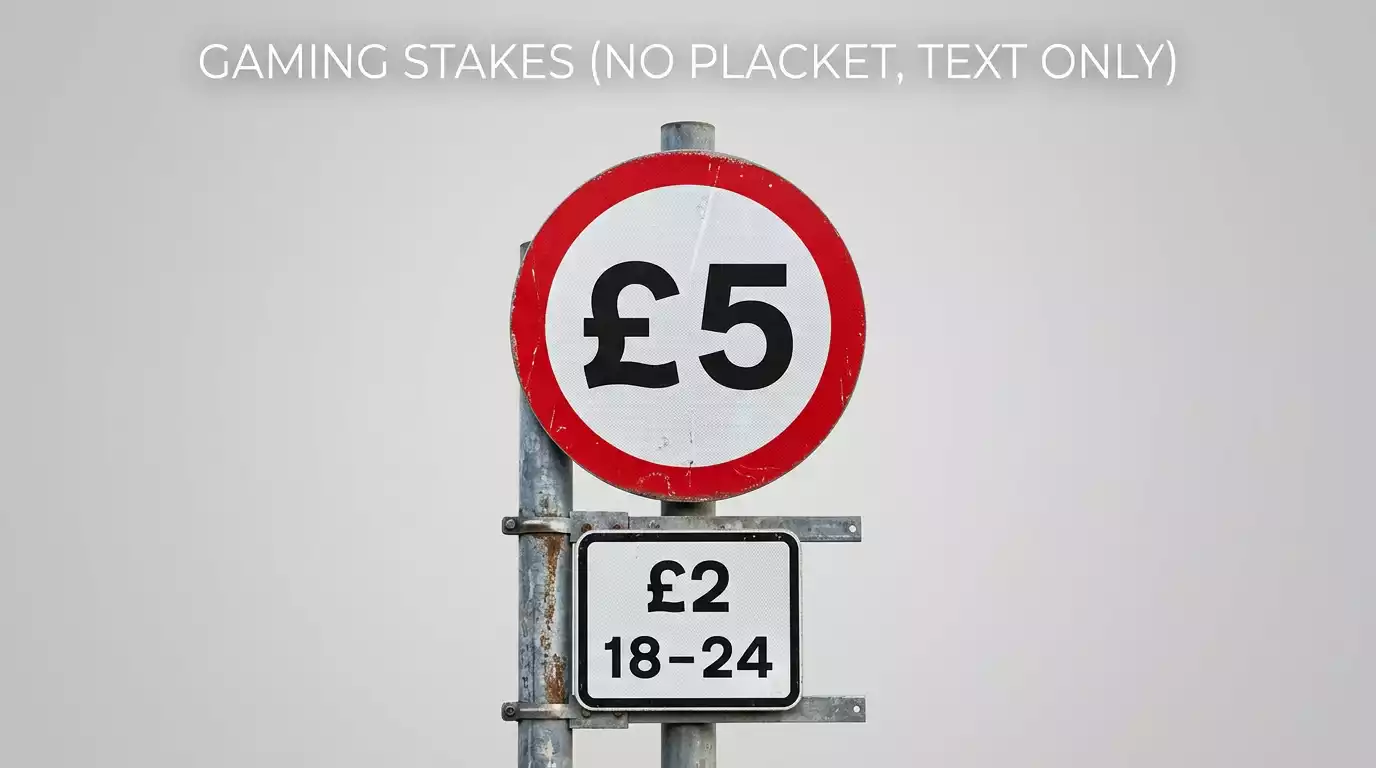
How the new stake limits change session loss rates
The stake-limit reform changed UK slot economics in concrete, measurable ways. Before 9 April 2025, the absence of a regulatory cap meant a player could (and many did) stake £10, £20, or higher per spin on online slots. At a 96% RTP slot, a £10-per-spin session at the industry-standard 600 spins per hour produced an expected loss of around £240 per hour. The £5 cap for over-25s halved that ceiling; the £2 cap for 18-24-year-olds (effective 21 May 2025) brought it down further to an expected loss of around £48 per hour at the same spin rate.
The actual session-level effect is larger than the headline reduction because the cap also constrains the variance. A player on a losing streak at high stakes can lose a substantial bankroll in minutes; the same player at capped stakes experiences a slower loss curve, with more opportunity for the affordability checks at the £150 net-deposit threshold (effective 28 February 2025) to trigger before losses compound. The two interventions — stake limit + affordability check — are designed to work together: the cap slows the rate of loss, the check intervenes when cumulative loss crosses the threshold.
Rouge Casino, as a Curaçao-licensed operator, is not subject to either intervention. Slot stakes are set by the operator and the game studio, not by the regulator. The affordability check infrastructure does not apply. For a UK player, this means session loss rates at Rouge Casino can match the pre-reform UK environment regardless of which date a deposit is made.
The Protection Gap: What You Lose at an Offshore Casino
When I conduct compliance reviews, I use a framework that maps every player protection mechanism at a licensed operator and then checks which of those mechanisms exist at the operator under review. For Rouge Casino, the result of that exercise is stark.
At a UKGC-licensed casino, you have access to a formal complaints process with escalation to an approved ADR provider. Your funds are held in segregated accounts, protected from the operator’s business creditors. Your self-exclusion preferences are respected across the entire licensed market through GamStop. Your stakes are capped, your affordability is monitored, and your right to withdraw winnings is enforced by a regulator with the power to revoke the operator’s licence. The structural difference between UKGC and Curaçao licensing is documented across multiple compliance dimensions — ADR access, fund segregation, affordability assessment, self-exclusion integration, stake limits. That difference is not abstract. It represents the concrete protections that exist at a UKGC-licensed site and are absent at an offshore operator.
Approximately 1.4 million British adults — about 2.5 percent of the adult population — experience some form of gambling problem. The UKGC’s regulatory framework is designed with those individuals in mind. Stake limits, affordability checks, self-exclusion schemes, mandatory responsible gambling messaging, and cooling-off periods are all mechanisms that exist because the evidence shows a significant number of players cannot adequately protect themselves. Helen Rhodes, the UKGC’s Director of Major Policy Projects, has framed the Commission’s work as giving players greater awareness and control over their gambling activities. At an offshore casino, that awareness and control rests entirely with the player.
The financial protections are the most tangible loss. At a UKGC-licensed site, if the operator becomes insolvent, player funds held in segregated accounts are protected. At an offshore site, player deposits are commingled with the operator’s business funds. If the operator closes, the money is gone. There is no Financial Ombudsman Service jurisdiction, no UKGC intervention, and no realistic legal avenue for recovery from a company registered in Curaçao.
I have worked with players who lost money at offshore casinos and attempted to pursue recovery through the operator’s jurisdiction. The process is expensive, slow, and overwhelmingly unsuccessful. The legal systems in offshore licensing jurisdictions are not designed to adjudicate individual player disputes with the efficiency or consumer-friendliness of UK mechanisms. A player who chooses Rouge Casino over a UKGC-licensed alternative is not just accepting different odds or different bonuses. They are accepting a fundamentally different relationship with risk — one where the safety net has been removed and the floor beneath it is a long way down.
Frequently Asked Questions
Has the UKGC ever fined or prosecuted a UK player for using an offshore casino?
No. The Gambling Act 2005 criminalises the provision of unlicensed gambling facilities, not the act of gambling at them. The legal liability sits with the operator, not the player. There is no recorded case of a UK player being fined or prosecuted for placing bets at an offshore casino. However, the absence of criminal liability does not mean the player is protected — it means the regulatory framework that would normally safeguard the player does not apply.
Do the new UK stake limits apply to Rouge Casino?
No. The online slot stake limits introduced in April 2025 — five pounds per spin for players aged 25 and over, two pounds for ages 18 to 24 — apply only to UKGC-licensed operators. Rouge Casino holds a Curaçao licence and is not subject to UKGC requirements. There is no external regulatory cap on stakes at the site.
If I self-excluded via GamStop, does Rouge Casino check the register?
No. GamStop participation is a condition of UKGC licensing. Rouge Casino does not hold a UKGC licence and is not required to check the GamStop register. A player who has self-excluded through GamStop can create an account and gamble at Rouge Casino without any intervention from the self-exclusion scheme.
What financial protections do UK players lose when gambling offshore?
At a UKGC-licensed casino, player funds are held in segregated accounts protected from the operator’s creditors, complaints can be escalated to an approved ADR provider, and the regulator can intervene if the operator refuses to pay winnings. At Rouge Casino, none of these protections apply. Player deposits are not ring-fenced, there is no ADR escalation path recognised by UK regulation, and the UKGC has no jurisdiction to compel the operator to act.