
 Available in GB
Content

0 Billion and Accelerating: The State of Online Gambling
I remember attending an iGaming conference in 2019 where a panellist predicted the global online gambling market would hit $100 billion by 2025. The room was sceptical. The actual figure for 2025? $130.2 billion (Research and Markets, Online Gambling Analysis Report 2026) — overshooting that prediction by thirty percent and projected to reach roughly $143 billion in 2026 at a 10% CAGR.
Scale like this changes how every participant in the ecosystem operates. Regulators are playing catch-up with an industry that moves faster than legislation. Operators are consolidating across borders. Software providers are building for mobile-first audiences in markets that barely existed five years ago. And players — across an ecosystem that industry analysts estimate at 5,000–8,000 casinos and online operators worldwide (IBISWorld, Statista) — are navigating an environment where the difference between a regulated, transparent operator and an unlicensed one is often invisible at first glance.
What follows is a data-driven snapshot of where the global online gambling market stands in 2026, which segments are driving growth, and what the projections tell us about where this industry is heading. The numbers come from multiple research houses, and — as I’ll explain — they don’t always agree.
The full assessment is in our Rouge Casino review.
Our top casino picks for the UK
- x3betBonus: Welcome Pack 100% Up to £1.000 + 200 Free Spins · Payout speed: 1-3 business days
- SpinFormulaBonus: 550% Up To £15,000 + 550 FS · Payout speed: 1-3 business days
- Revery PlayBonus: 100% up to€1,000+ 100 FS · Payout speed: 1-3 business days
- AmunbetBonus: Join now and get 450% up to 2,700 GBP + 450 FS · Payout speed: 1-3 business days
- SlotoSportBonus: 500% up to £ 10 200+ 777 FS · Payout speed: 1-3 business days
- NightLuckBonus: Welcome Pack + 805% Up To 6400€ + 280 FS · Payout speed: 1-3 business days
- EvoSpinBonus: 125% up to €2500 + 125 Free Spins · Payout speed: 1-3 business days
Market Size: Estimates and Measurement Approaches
Pinning down the exact size of the global online gambling market is harder than it should be, and that difficulty is itself a useful data point. The figure I use as a baseline — $130.2 billion in 2025, projected to grow to $143.17 billion in 2026 — comes from a widely cited market report using a 10% compound annual growth rate. But other research houses produce different numbers depending on what they include and exclude.

The divergence centres on three variables. First, definition: does “online gambling” include online lottery ticket sales? Sports betting via mobile apps? Social casino games where no real money changes hands? Different reports draw different boundaries. Second, geography: some estimates exclude grey and black markets — jurisdictions where online gambling operates without clear legal frameworks — while others attempt to estimate their contribution. Third, currency: dollar-denominated reports produce different totals depending on which exchange rates they apply and when.
Total global gambling revenue — including land-based casinos, betting shops, lotteries, and online — exceeded $643 billion in 2025. Online gambling’s share sits at approximately 20% of that total, a figure that has been climbing steadily as retail gambling stagnates in most developed markets. The percentage matters because it frames online gambling not as a niche digital vertical but as one-fifth of a vast global industry — and the fastest-growing fifth at that.
When I cite market size figures in compliance work, I always note the source and methodology. Not because the numbers are unreliable, but because a $10-15 billion variance between estimates is normal at this scale, and precision matters less than direction. The direction is unambiguous: up, fast, and accelerating.
Sports Betting at 52%: The Dominant Segment
If you assumed online casinos were the largest revenue segment in the global online gambling market, you’d be wrong — and I made the same assumption early in my career. Sports betting accounted for 52.05% of all online gambling revenue in 2025, making it the dominant segment by a considerable margin.
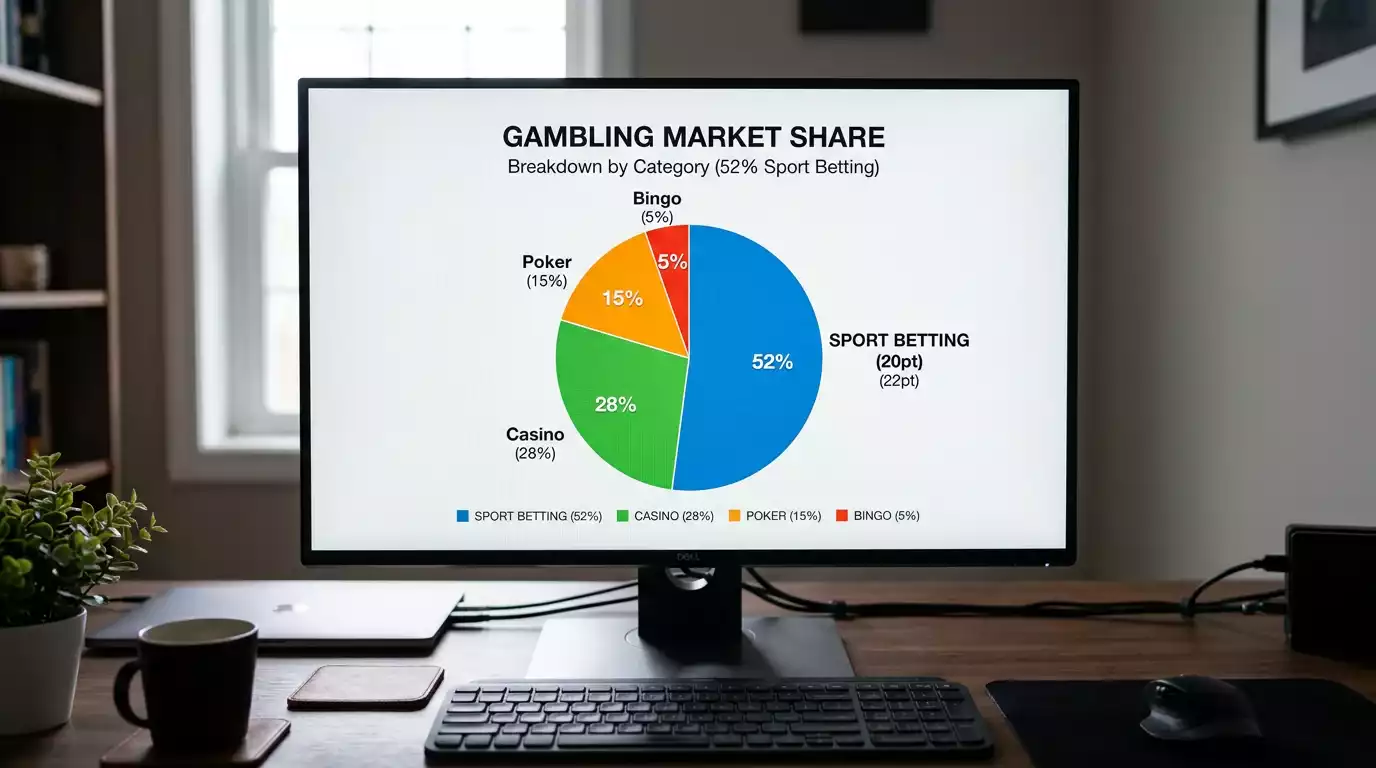
The reason is structural rather than cultural. Sports betting scales differently from casino gaming. A single Premier League match generates thousands of betting markets — match result, correct score, first goalscorer, corners, cards, half-time results, in-play markets that update with every passage of play. Multiply that by every league, every sport, every day, and the volume of available markets dwarfs what even the largest online casino can offer in slot and table game variety. Each market is a transaction opportunity, and the aggregate volume is enormous.
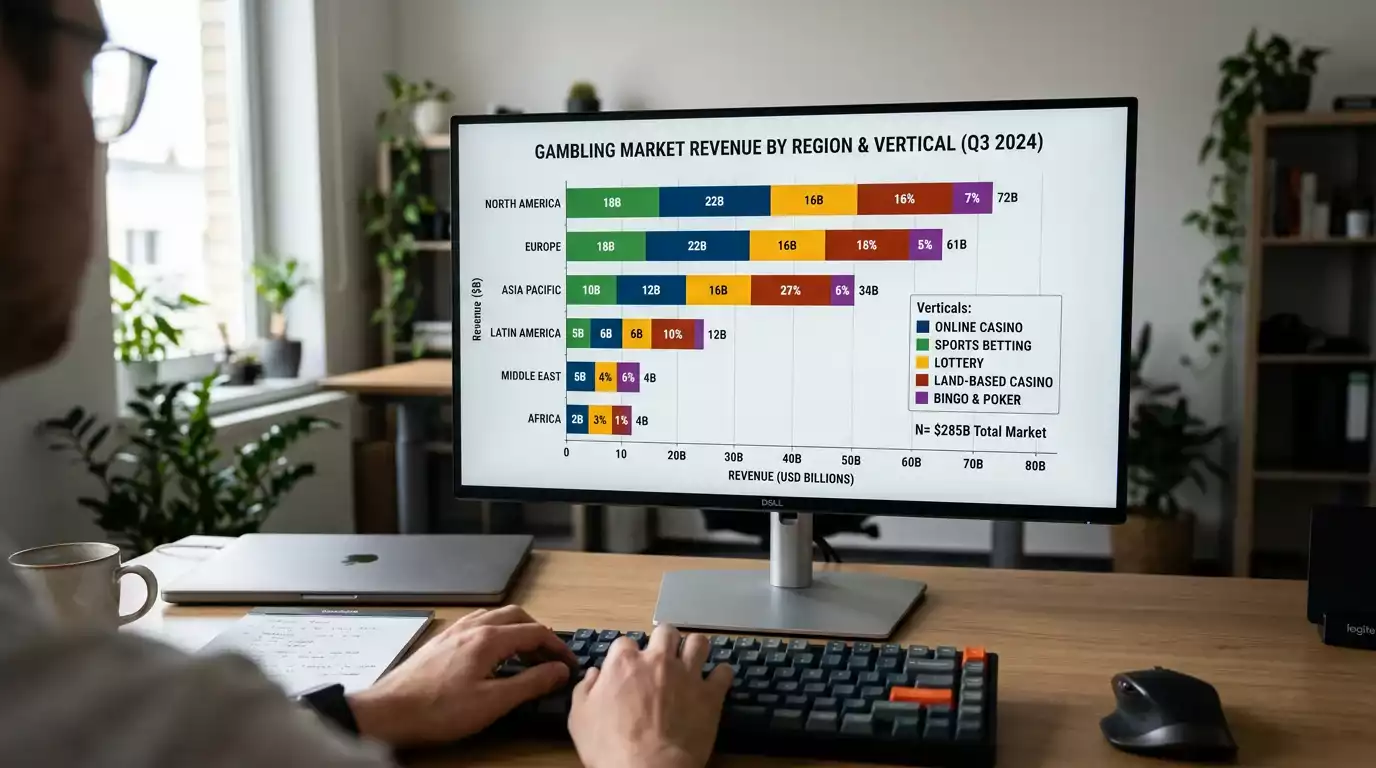
The legalisation wave in the United States has been a significant accelerant. States that have opened to legal sports betting since 2018 — now the majority — have added billions in annual handle. But the trend isn’t limited to North America. Latin America, parts of Africa, and Southeast Asia are all seeing rapid growth in mobile sports betting, driven by smartphone penetration and the global reach of popular sports leagues.
For UK players, the sports betting dominance is relevant context when evaluating any operator — including offshore platforms. An operator that offers only casino games is fishing in the smaller pool. An operator that combines sports betting with casino products is operating in the revenue model that the broader market has validated as most sustainable. It does not make the operator trustworthy, but it does tell you something about its business model and scale ambitions.
80% on Smartphones: The Mobile-First Reality
Three years ago, a compliance consultant I work with stopped testing casino sites on desktop entirely. Her reasoning was simple: nearly 80% of online gamblers use smartphones as their primary device, and if an operator’s mobile experience is broken, that’s what matters. Desktop had become the edge case.

The shift to mobile is not evenly distributed. In mature markets like the UK, mobile gambling has been dominant for several years — driven by fast mobile networks, high smartphone ownership, and operators that invested heavily in responsive design and native apps. In emerging markets, mobile isn’t just dominant; it’s often the only access point. Players in parts of Africa and South Asia may never gamble on a desktop computer because they don’t own one. Their entire relationship with online gambling exists on a five-inch screen.
This has regulatory implications that are still catching up with reality. The UKGC’s affordability checks, stake limits, and self-exclusion tools were designed with desktop interfaces in mind and retrofitted to mobile. The user experience of receiving an affordability check notification on a mobile device — mid-session, on a small screen, with limited attention — is meaningfully different from receiving one on a desktop where you’re more likely to be in a deliberate, seated context. Whether the mobile experience of harm-prevention tools is as effective as the desktop equivalent is a question regulators are only beginning to study.
For offshore operators, mobile-first design is both an opportunity and a risk amplifier. The speed and convenience of mobile gambling means deposits happen faster, sessions start more impulsively, and the friction that might cause a player to pause and reconsider is reduced. At an operator without affordability checks or session limits — which describes most Curaçao-licensed platforms — mobile access removes the last remaining sources of friction between impulse and action.
The British share of it: the UK market in 2026.
Projections to 2030: 2 Billion Forecast
Market researchers project the global online gambling market will reach $212.44 billion by 2030, implying a compound annual growth rate of 10.4% from current levels. Those are headline figures, and headlines always deserve scrutiny.
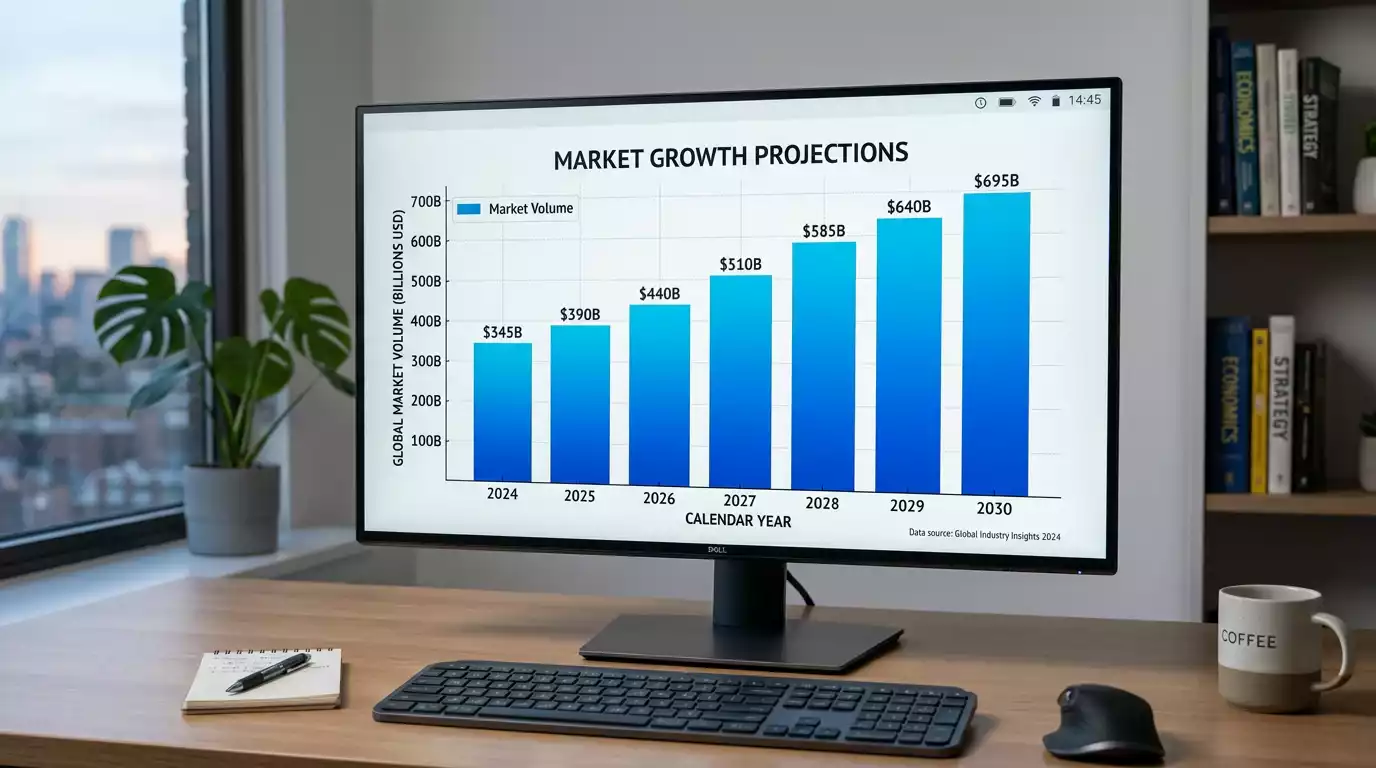
The bullish case rests on several converging trends: continued legalisation in new jurisdictions (particularly in Asia and Latin America), growth in mobile penetration, increasing acceptance of cryptocurrency as a payment method — the crypto gambling market alone reached an estimated $81 billion in 2025 — and demographic shifts as younger generations who grew up with smartphones enter the gambling market. Each of these trends has historical momentum behind it, and none shows signs of reversing.
The bearish case, which fewer analysts emphasise, focuses on regulatory tightening. The UK’s April 2026 increase in Remote Gaming Duty from 21% to 40% is the most aggressive example, but it reflects a broader pattern. Governments that initially welcomed online gambling revenue are now grappling with social costs — problem gambling, money laundering, youth exposure — and responding with higher taxes, stricter advertising rules, and tighter operator requirements. If enough jurisdictions tighten simultaneously, growth projections built on current regulatory assumptions will need revision.
My own view, informed by eight years of watching this market, is that the $212 billion figure is plausible but not inevitable. The market will grow. The rate depends on whether the regulatory environment evolves fast enough to maintain public confidence without choking legitimate operators out of the market — and whether unlicensed platforms continue to absorb the players that stricter regulation pushes away from licensed alternatives. That tension between protection and accessibility is the defining dynamic of online gambling’s next decade.
How much of total gambling revenue comes from online?
Online gambling accounts for approximately 20% of total global gambling revenue, which exceeded $643 billion in 2025. The online share has been growing steadily as land-based gambling stagnates in most developed markets. By 2030, some analysts expect online to account for 25-30% of total gambling revenue worldwide.
Which region dominates the global online gambling market?
Europe remains the largest regional market for online gambling, driven by mature regulatory frameworks in the UK, Malta, and Scandinavia. North America is the fastest-growing region, propelled by state-by-state sports betting legalisation in the US. Asia-Pacific represents significant untapped potential but faces fragmented regulation and substantial grey-market activity.