
 Available in GB
Content
- Software Providers Listed vs Verified
- Slot Categories: What's Available and What's Missing
- Live Dealer Section: Providers and Stream Quality
- RTP at Rouge Casino: How to Check If Numbers Are Real
- Counterfeit Games at Offshore Casinos: The Risks
- Game Fairness Oversight: Offshore vs UKGC-Regulated Sites
- Frequently Asked Questions
- Related guides in this section

Last year, I helped a player verify whether the slot games at an offshore casino were genuine. They were not. The operator had sourced pirated copies of popular titles from a black-market API provider, running games that looked identical to the originals but had been modified to deliver lower payouts. The player had no idea. The games had the right names, the right graphics, and the right sound effects. The only thing missing was the legitimate RTP — and you cannot see that by looking at the screen.
This is the fundamental challenge with evaluating games at any offshore casino, including Rouge Casino. The game library may list recognisable provider names and popular titles. The interface may feel polished and professional. But without independent verification, there is no reliable way for a player to confirm that the games they are playing are genuine, unmodified, and running at the RTP advertised by the original developer. Thirty-nine percent of unlicensed casinos use manipulated games with RTP significantly lower than advertised. That number should inform how you approach any game at a site operating outside UKGC oversight.
What follows is a systematic assessment of Rouge Casino’s game library — not a catalogue of what is available, but an analysis of what can and cannot be verified. I will walk through the software providers, slot categories, live dealer offerings, and RTP transparency, applying the same verification methods I use in professional compliance reviews. The goal is not to tell you whether the games are good or bad. The goal is to give you the tools to answer that question yourself, using evidence rather than the operator’s marketing materials.
The full assessment is in our Rouge Casino review.
Software Providers Listed vs Verified
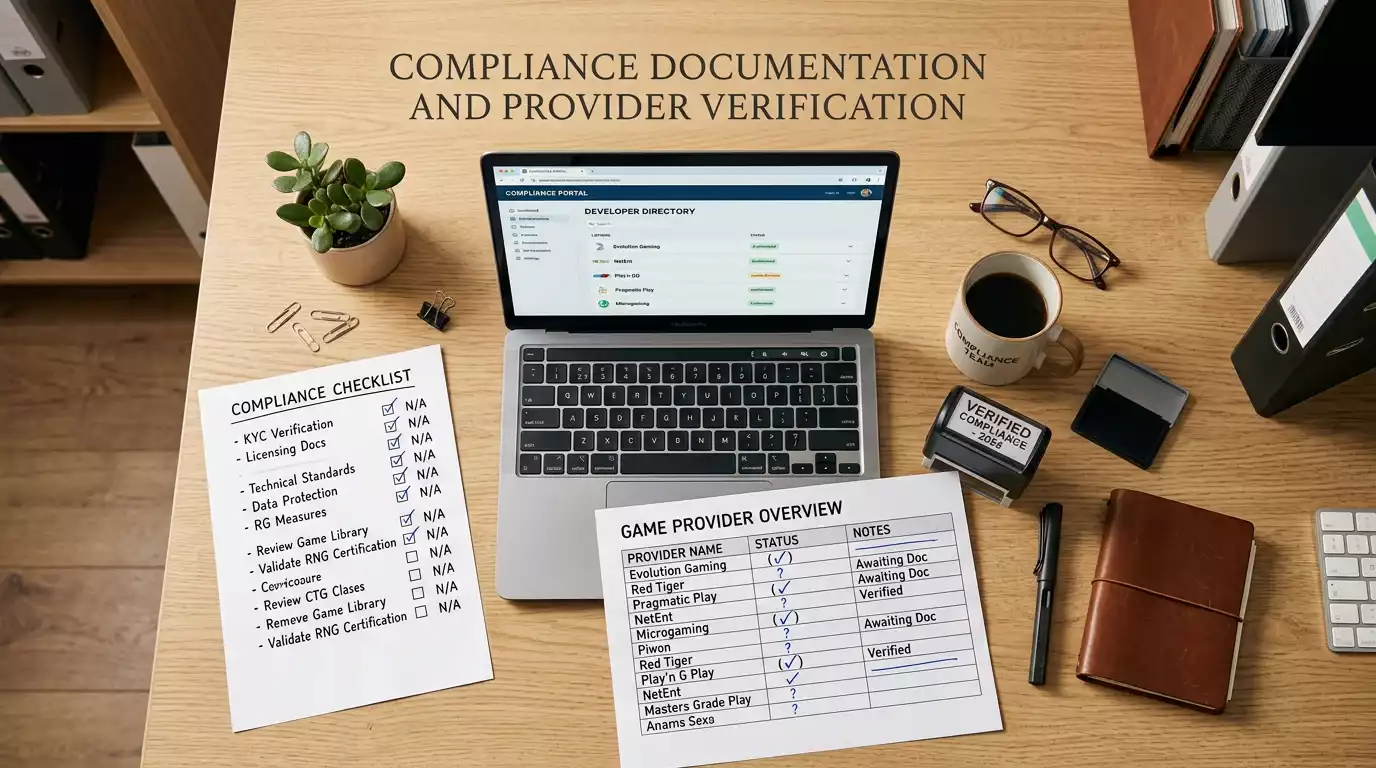
When I review a casino’s game library, the first thing I look at is not the number of games. It is the list of software providers — and whether those providers actually supply the site.
Rouge Casino lists a range of game providers on its platform, including names that are well known in the iGaming industry. The question is whether those providers have entered into legitimate distribution agreements with Rouge Casino’s operator, or whether the games are sourced through aggregator platforms that may or may not have proper licensing from the original developers.
The distinction matters enormously. When a major provider like Evolution, Pragmatic Play, or NetEnt supplies a game through an authorised channel, the game runs on the provider’s own servers with the provider’s certified RNG (Random Number Generator). The operator cannot modify the game’s RTP or payout structure. The provider’s reputation and licensing obligations depend on the integrity of their software, so they have strong incentives to ensure it is not tampered with.
When games are sourced through unauthorised channels — and this is where the offshore market gets murky — the game may run on a third-party server that the original provider does not control. The visual presentation can be identical, but the underlying maths can be altered. I have seen cases where the RTP of a pirated slot was set to 85% instead of the 96% the legitimate version delivers. The player sees the same game, spins the same reels, and has no way of knowing that their odds are dramatically worse.
Verifying provider authenticity is possible but requires effort. Most major providers publish lists of their licensed operator partners. If Rouge Casino claims to offer games from a specific provider, you can check the provider’s website to see if the operator or its parent company is listed. If it is not, that does not automatically mean the games are pirated — distribution chains can be complex — but it is a red flag that warrants caution. The absence of verification tools at the casino itself, such as in-game provider seals that link to the developer’s domain, is another warning sign.
Slot Categories: What’s Available and What’s Missing
Rouge Casino’s slot library, by the numbers, appears substantial. Hundreds of titles across multiple categories: video slots, classic slots, jackpot slots, megaways variants. The volume is impressive on paper. But volume and quality are not the same thing, and a large library at an offshore casino raises its own set of questions.
Online slots generated 4.2 billion pounds in Gross Gambling Yield in the UK alone in the year ending March 2025. That revenue figure reflects the dominance of slots in the online casino market and explains why they are the centrepiece of every operator’s game library. What it does not explain is why an offshore operator with a Curaçao licence would have access to the same game catalogue as a UKGC-licensed site. Many top-tier providers restrict distribution to regulated markets. Their licensing agreements may prohibit their games from appearing on sites that are not licensed in the player’s jurisdiction. If Rouge Casino offers games from providers who have publicly stated they do not supply unlicensed operators in the UK market, that inconsistency deserves scrutiny.
What tends to be missing from offshore casino libraries is the depth of niche content. Branded slots — games based on films, TV shows, or music acts, which involve expensive licensing deals — are less common at offshore operators because the rights holders typically require the casino to hold a reputable licence. Table game variants with innovative mechanics, provider-exclusive titles, and tournament functionality are also less prevalent. The result is a library that looks broad but may lack the range of a well-curated UKGC-licensed catalogue.
There is also the question of game categorisation transparency. At a well-regulated casino, each game’s category, provider, RTP, and volatility rating are typically accessible through filters and information screens. Rouge Casino’s library may offer category filters, but whether the information behind those filters is accurate and complete is a different matter. If a game is listed as “high RTP” but no independent source confirms that rating, the categorisation becomes a marketing claim rather than a verifiable fact. I have seen offshore operators categorise games by RTP bands that do not match the developer’s published specifications — a subtle form of misrepresentation that exploits players who use filters to select games based on expected returns.

Live Dealer Section: Providers and Stream Quality
The live casino category deserves separate discussion because the economics and verification dynamics are different from slots.
Live dealer games are streamed in real time from studio facilities, with human dealers managing physical cards, wheels, and dice. The major live casino providers — Evolution being the dominant player — operate from purpose-built studios with multiple camera angles, professional dealers, and regulated oversight of the physical game environment. When a live game is supplied through an authorised channel, the integrity of the game is maintained by the studio’s own regulatory obligations.
At Rouge Casino, the live casino section lists multiple game types: blackjack, roulette, baccarat, and game show formats. The critical question is whether these streams originate from licensed studios with independent regulatory oversight, or from unlabelled facilities with no external verification. Some offshore operators contract with smaller, less regulated studio providers who may not maintain the same standards as the major brands. Others integrate legitimate streams from major providers but through distribution channels that the provider may not have explicitly authorised for the specific market being served.
For a UK player, the practical difference is significant. A live roulette stream from an Evolution studio in Riga, operating under an MGA licence, is subject to physical randomness and regulatory camera surveillance. The game cannot be rigged in the way a digital slot can be modified. But if the stream comes from an unlabelled studio with no disclosed location or regulatory affiliation, the player has no way of verifying the integrity of the dealing process. I have encountered offshore casinos where the “live” stream was actually pre-recorded footage spliced with automated outcomes — a sophisticated deception that only becomes apparent if you monitor the stream for inconsistencies over extended play sessions.
The verification steps for live casino games are different from those for slots. Look for on-screen studio identification — legitimate Evolution streams, for example, display studio and table identifiers visible in the interface. Check whether the game lobby shows the provider’s official branding, not a generic wrapper. And pay attention to stream quality: major providers invest heavily in production value, with multiple camera angles, consistent lighting, and professional dealers. If the stream looks amateurish, with single-angle footage and dealers who appear untrained, you are likely not looking at a product from a tier-one live casino provider.

The live tables assessed separately: the live dealer games.
RTP at Rouge Casino: How to Check If Numbers Are Real
RTP — Return to Player — is the single most important metric for any casino game, and it is the metric that offshore operators are most likely to misrepresent. I want to walk through how RTP works, how to verify it, and why the verification problem is more severe at offshore sites.
Every slot game has a theoretical RTP set by the developer. A game with 96% RTP will, over millions of spins, return 96 pence for every pound wagered. The remaining 4% is the house edge. This is a statistical average, not a per-session guarantee — individual sessions can produce results far above or below the theoretical RTP. But over time, the maths converges.
At a UKGC-licensed casino, game RTP is verified by approved testing houses. The testing house audits the game software, confirms the RNG is truly random, and certifies that the RTP matches the developer’s specification. The operator cannot modify the RTP without regulatory approval. If a player suspects foul play, the UKGC can require the operator to produce audit records, and the testing house’s certification provides an independent point of verification.
At Rouge Casino, operating under a Curaçao licence, the verification infrastructure is weaker. Curaçao does not mandate independent RTP audits with the same rigour as the UKGC or MGA. The operator may publish RTP figures — in the game information screens or on the website — but there is no independent body confirming that these figures reflect the actual game performance. The operator, or a third-party API provider, could in theory adjust the RTP without the player’s knowledge or the regulator’s scrutiny.
Think of it this way. Buying a used car from a dealership that is subject to consumer protection law gives you legal recourse if the odometer has been wound back. Buying the same car in a private sale across a border, where none of those protections apply, puts the verification burden entirely on you. The car might be fine. But the system around you is not designed to catch problems, so you had better be thorough with your own checks.
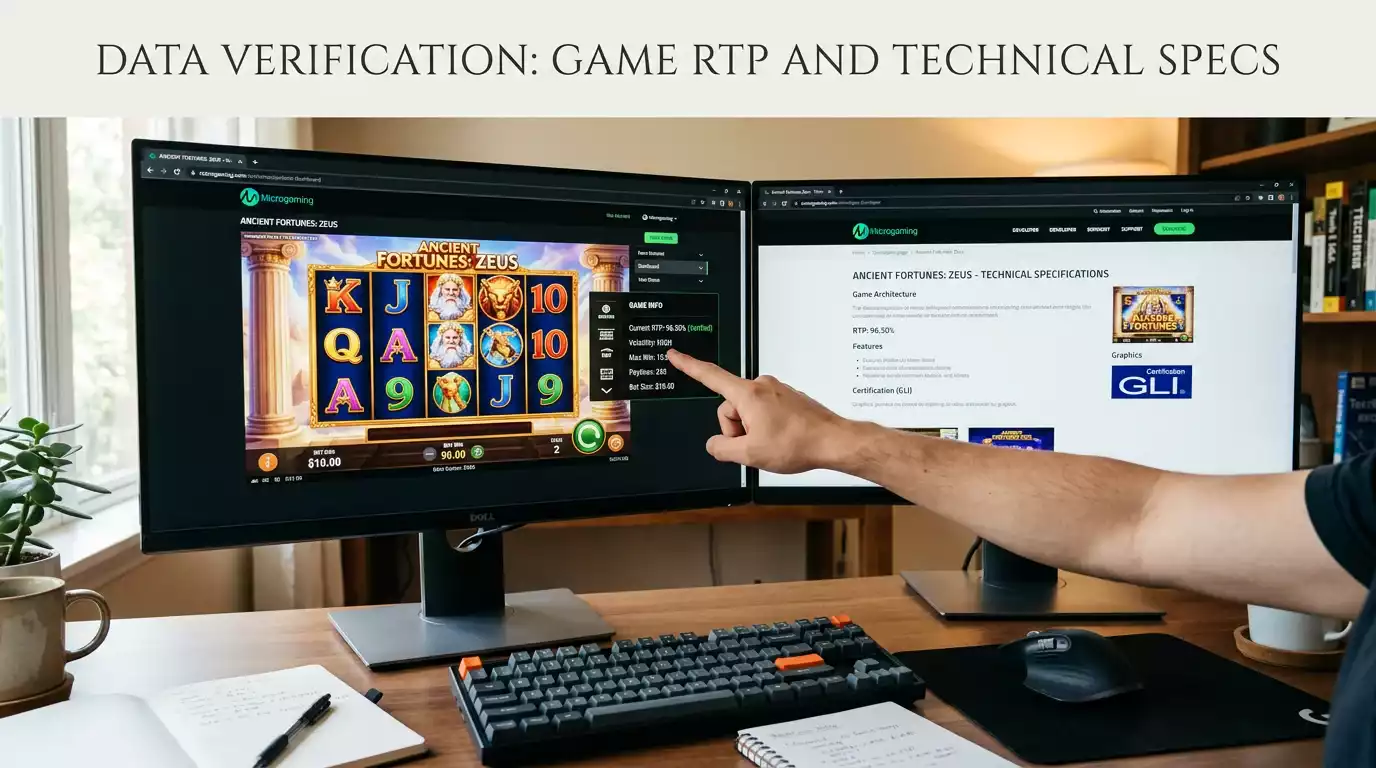
How do you verify RTP yourself? The most reliable method is to check the game developer’s website. Providers like Pragmatic Play and NetEnt publish the theoretical RTP for each game. If the RTP displayed at Rouge Casino differs from the developer’s published figure, that discrepancy is a clear warning sign. You can also check in-game information screens — most legitimate games display the RTP in the help or info section. If this information is absent, or if the game lacks an info screen entirely, that is another red flag. For a deeper dive into how RTP works and how to verify return-to-player percentages independently, our dedicated guide covers the verification process step by step.
How RTP is calculated and reported
Return-to-Player is the theoretical long-run percentage of wagered money that a slot returns to players, calculated over a sample of typically 10 million to 100 million simulated spins. A 96% RTP slot returns £96 for every £100 wagered, on average, across that sample. The figure is computed by the game studio at design time and verified by an independent test house — GLI, BMM, or iTech Labs are the dominant names — before the slot is certified. The published RTP appears in three places: the studio’s own game-information PDF, the game’s in-client paytable (usually accessible from the spin screen), and the casino’s game-rules page where one exists.
The 96% RTP does not mean a player will retain 96% of their stake on any individual session. It is a long-run figure, and short-session variance can swing in either direction by tens of percentage points. What it does guarantee is the central tendency: over enough spins, results converge to the published figure. Slots with multiple selectable RTP versions (some studios ship 96%, 94%, and 92% variants of the same slot, configurable per operator) carry the studio’s full disclosure of which version is loaded at a given casino. UKGC operators are required to display the active RTP variant prominently; offshore operators are not.
RTP vs volatility: two different measures of risk
RTP and volatility describe different aspects of slot behaviour. RTP is the long-run return percentage; volatility (also called variance) describes the shape of the return distribution. A high-volatility slot pays out infrequently in large amounts; a low-volatility slot pays out frequently in small amounts. Two slots with identical 96% RTP can have radically different volatility profiles, and the volatility profile is what determines session-level experience — bankroll requirements, win-frequency expectations, and the probability of long dry stretches without a meaningful payout.
Slot studios publish volatility as either a verbal scale (Low / Medium / High / Very High) or a numeric scale (1 to 10). Volatility is the more practically actionable number for a recreational player choosing a slot: a £20 session on a Very High volatility slot is materially likelier to end with zero balance after fifty spins than a £20 session on a Low volatility slot at the same RTP, even though their long-run returns are identical.
Counterfeit Games at Offshore Casinos: The Risks
I need to be direct about something that most casino reviews avoid discussing: counterfeit games are a real and growing problem in the offshore market, and the risk at any Curaçao-licensed operator is non-trivial.
The mechanism is straightforward. A legitimate game developer creates a slot title with specific RTP, volatility, and RNG characteristics. That game is distributed to licensed operators through authorised APIs. In the offshore market, operators can access pirated copies of these games through black-market API providers. These copies replicate the visual and audio presentation of the original but run on modified software. The modifications typically reduce the RTP, increase the volatility, or both — extracting more money from players per session while offering an experience that appears identical to the genuine product.
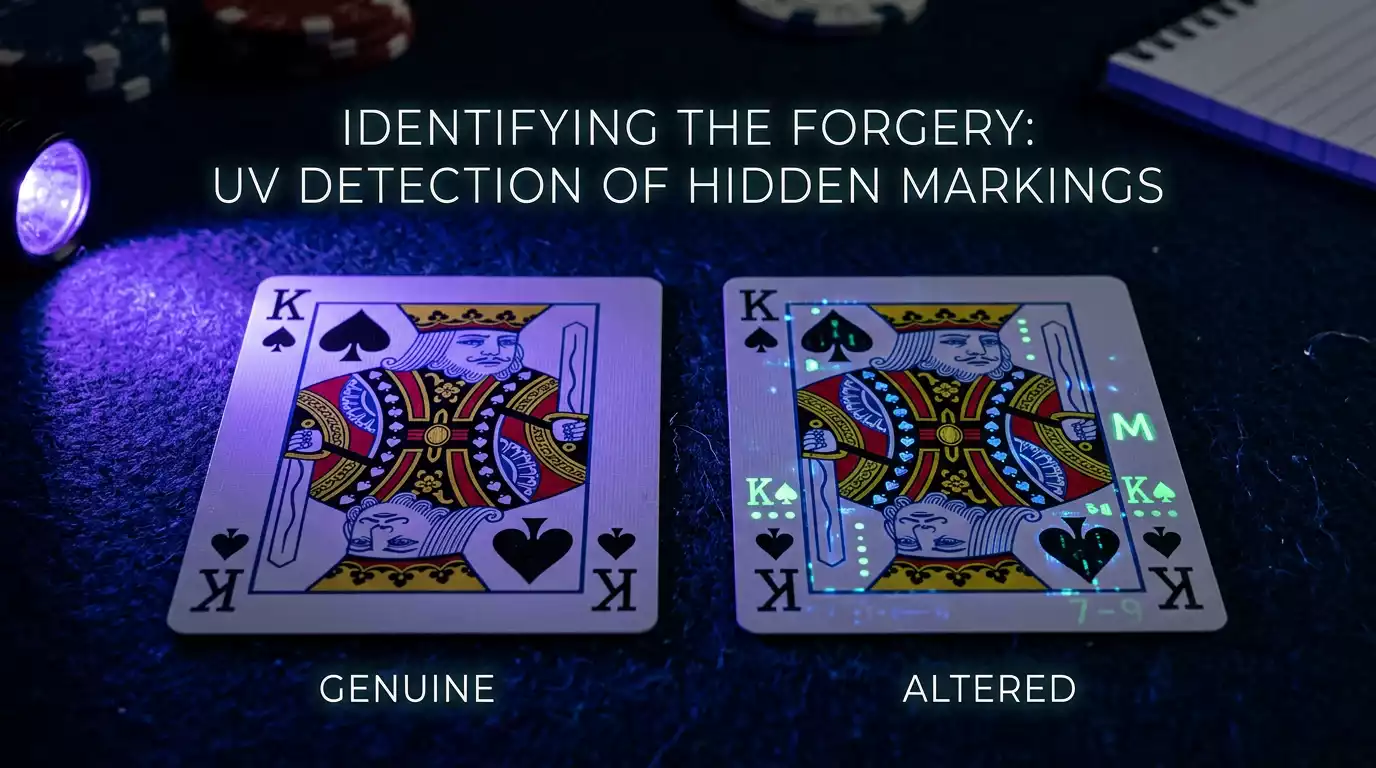
In Q1 2025, cybersecurity firms identified 782 malicious casino websites, many of which were running counterfeit game content. The sophistication of these copies has increased to the point where visual inspection alone is insufficient to distinguish genuine from counterfeit. The game logos, animations, bonus features, and paytable displays can all be replicated. Only the underlying mathematics is different — and that is invisible to the player.
The risk is compounded by the absence of independent auditing at many offshore casinos. At a UKGC-licensed site, if a player suspects a game is not performing according to its stated RTP, the regulator can compel the operator to produce audit logs and testing house certifications. At a Curaçao-licensed site, this recourse does not exist in any practically accessible form. The player is left with the choice of trusting the operator’s representation or not playing at all.
SOFTSWISS noted in its 2026 iGaming trends report that responsible gambling is shifting from a compliance checkbox to a strategic pillar of sustainable business growth. Part of that shift involves game integrity. Operators who can demonstrate independently verified game fairness will increasingly differentiate themselves from those who cannot. For Rouge Casino, the absence of publicly accessible audit reports or testing house certifications leaves the question of game integrity unanswered.
Game Fairness Oversight: Offshore vs UKGC-Regulated Sites
The difference in game fairness oversight between offshore and UKGC-regulated environments is not a spectrum. It is a binary.
At a UKGC-licensed casino, game software must be tested by approved testing houses before it goes live. The testing covers RNG integrity, RTP accuracy, and compliance with the regulator’s technical standards. Ongoing monitoring requirements mean that operators must maintain audit trails and make them available to the regulator on request. If a game is found to be performing outside its certified parameters, the operator faces regulatory action. The system creates multiple checkpoints where fraud, error, or manipulation can be detected and addressed.
UKGC-licensed casinos operate under one of the most rigorous game-integrity frameworks globally. The UKGC’s Remote Gambling and Software Technical Standards (RTS) require certified RNG implementation, independent testing of game outcomes by approved test houses, and published RTP for every slot. Players at UKGC-licensed casinos can be reasonably confident that the games they play are genuine and that the odds are as advertised. Reasonable confidence is not absolute certainty — no system is perfect — but it is a fundamentally different proposition from the offshore alternative.
At a Curaçao-licensed operator like Rouge Casino, the game fairness framework is less prescriptive, less transparent, and less enforceable. There may be testing requirements under the post-2023 CGA regime, but the public evidence of their implementation is limited. There is no equivalent of the UKGC’s published testing house approvals. There is no publicly accessible register of certified games. And there is no enforcement record demonstrating that operators have been sanctioned for running manipulated software.
For a UK player accustomed to the UKGC environment, playing at an offshore casino represents a fundamental shift in the trust model. At a UKGC site, you trust the system — the regulator, the testing houses, the enforcement mechanisms. At an offshore site, you trust the operator. The complaint records, the safety index scores, and the absence of independent verification all bear on whether that trust is warranted. In the case of Rouge Casino, the available evidence does not make a strong case for it.

Frequently Asked Questions
How can I tell if a slot at Rouge Casino is genuine or counterfeit?
Check the game developer’s official website for the published RTP and compare it to the figure displayed in the game’s info screen at Rouge Casino. If the figures differ, or if the game lacks an info screen showing RTP, that is a warning sign. You can also check whether the developer lists Rouge Casino or its parent company as an authorised distribution partner. The absence of in-game provider seals linking to the developer’s domain is another indicator of potentially unauthorised game content.
Does Rouge Casino publish independently audited RTP reports?
As of mid-2026, there is no publicly accessible independent RTP audit report for Rouge Casino’s game library. UKGC-licensed operators are required to use approved testing houses and maintain audit trails. Rouge Casino, operating under a Curaçao licence, is not subject to the same requirements, and no independent testing house certification has been publicly associated with the site.
Which game providers are confirmed to supply Rouge Casino?
Rouge Casino lists several game providers on its platform, but independent verification of each provider’s distribution agreement with the operator is difficult without direct confirmation from the providers themselves. Players can cross-reference the provider list against each developer’s official partner directory, where available. Discrepancies between what the casino claims and what the developer confirms should be treated as a red flag.
Are live dealer games at Rouge Casino streamed from licensed studios?
The origin and licensing status of Rouge Casino’s live dealer streams is not independently verified through publicly available information. Major live casino providers like Evolution operate from regulated studios, but whether Rouge Casino accesses these streams through authorised channels or through third-party integrators is not transparently documented. Players should look for in-stream branding and studio identification markers as indicators of legitimacy.